At 62, the calculus of time fundamentally changes.
For decades, like most professionals, I had a transactional relationship with time. You dedicate your weeks to the company, and in exchange, you build a career, provide for your family, and solve complex problems. But recently, I decided to step away from the Chief Architect desk. I am retiring from corporate life—but “retiring” in this context doesn’t mean retreating to a rocking chair. It means I am no longer selling my time to a company. Instead, I am managing it myself once again.
As I transition toward a part-time advisory role and launch my own local AI consulting practice, the shift from a structured 40-hour corporate week to complete temporal freedom is jarring. When you are the sole architect of your days, how do you ensure you don’t squander them?
The catalyst for my answer came from an unexpected place: Tim Urban’s brilliant TED Talk, Inside the Mind of a Master Procrastinator.
Toward the end of his talk, Urban introduces a concept that completely bypasses the standard productivity advice of calendars and to-do lists. He introduces the “Life Calendar”, a simple grid containing one box for every week of a 90-year life.
There are no endless pages to flip through. It all fits on one screen. When you look at time visually, stripped of its endless, nebulous illusion, it hits you like a freight train.
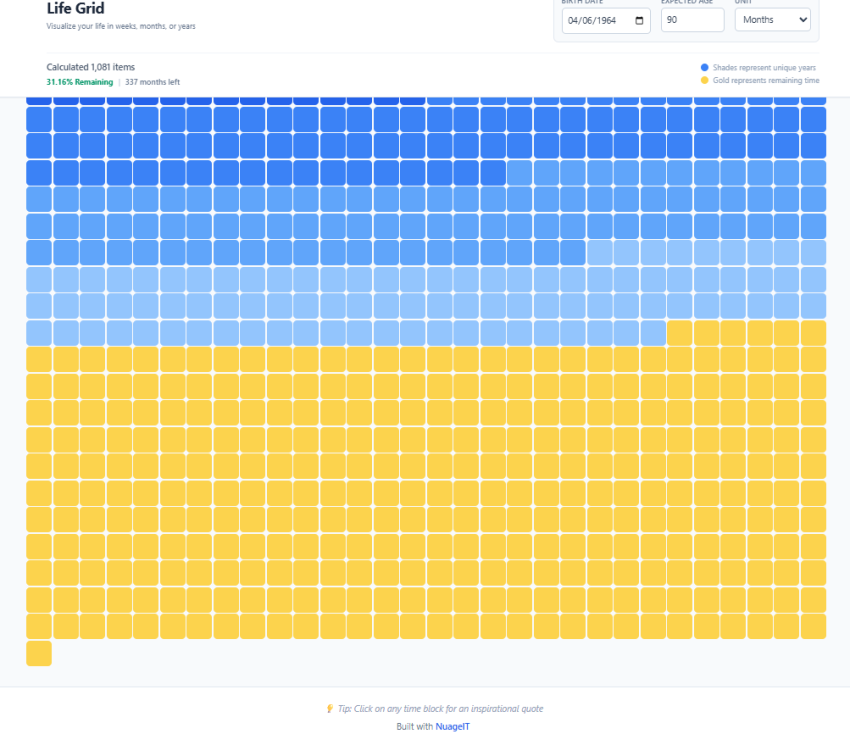
I couldn’t shake the visual, so I decided to build my own version of it. I wrote a web application—the Life Grid Visualizer—to make this concept tangible and interactive.
The tool is straightforward: you input your birth date and your expected lifespan, and it generates your personal grid in weeks, months, or years. The past years are shaded in, a visual ledger of the time already spent. But the real power lies in the blocks that remain, which the tool illuminates in stark, undeniable gold.
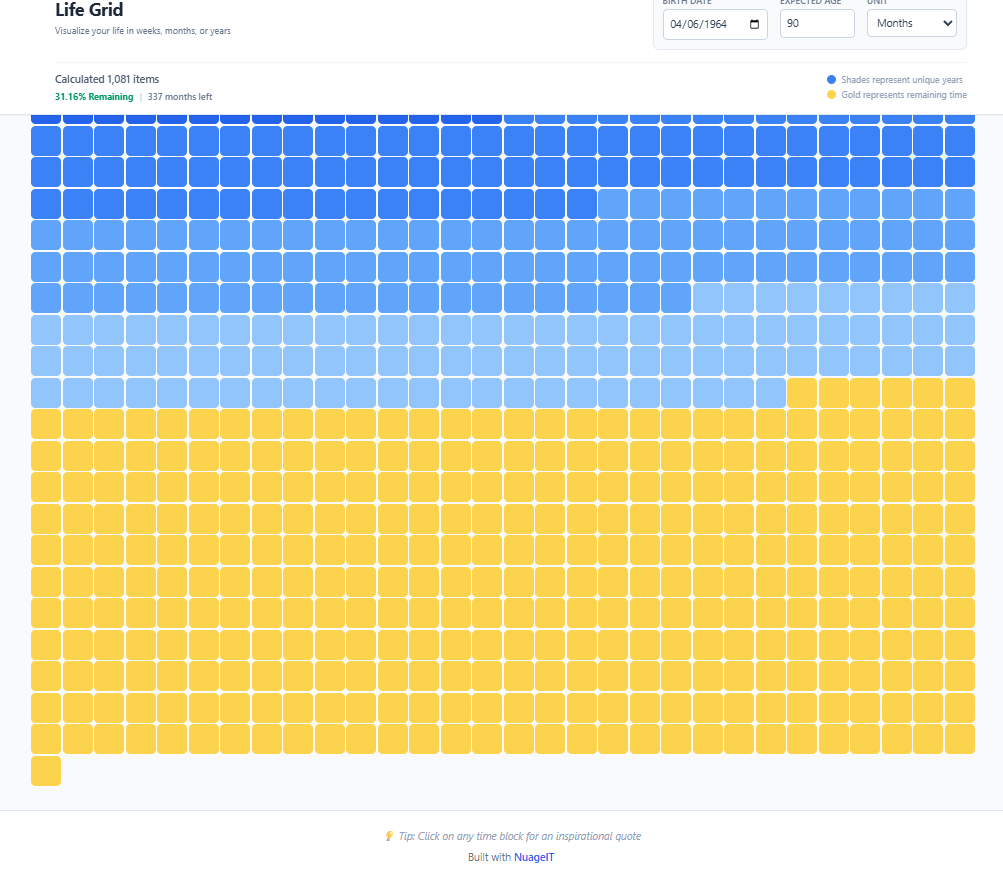
Watching those gold squares populate the screen isn’t morbid; it is intensely clarifying. It visually represents my remaining runway. It tells me exactly how much time I have left to build my new consulting firm, to spend with my wife, to visit my sons, and to travel the globe.
To add a layer of daily motivation, I programmed the grid so that clicking on any of those time blocks reveals an inspirational quote. It serves as a micro-reminder that every single one of those squares is a gift waiting to be utilized.
When you sell your time to a corporation, it is easy to let the weeks blur together into quarters and fiscal years. You operate under the illusion that there is always another quarter to catch up on your personal goals. The Life Grid destroys that illusion. It forces a mindset of relentless intentionality.
I am no longer optimizing enterprise systems; I am optimizing my remaining gold squares. Every project I take on, every piece I write on AI & data management, and every morning I wake up to a blank slate is now measured against that grid.
We are all living on a grid, whether we choose to look at it or not. The question is: who owns your remaining squares, and what are you going to do with them this week?